Feed performance, 7 min read
Where uneaten feed goes, and how to waste less of it on the farm
How uneaten pellets differ from faecal losses, why fish leave feed, how to detect waste in cages and tanks, and the practical steps that reduce it.
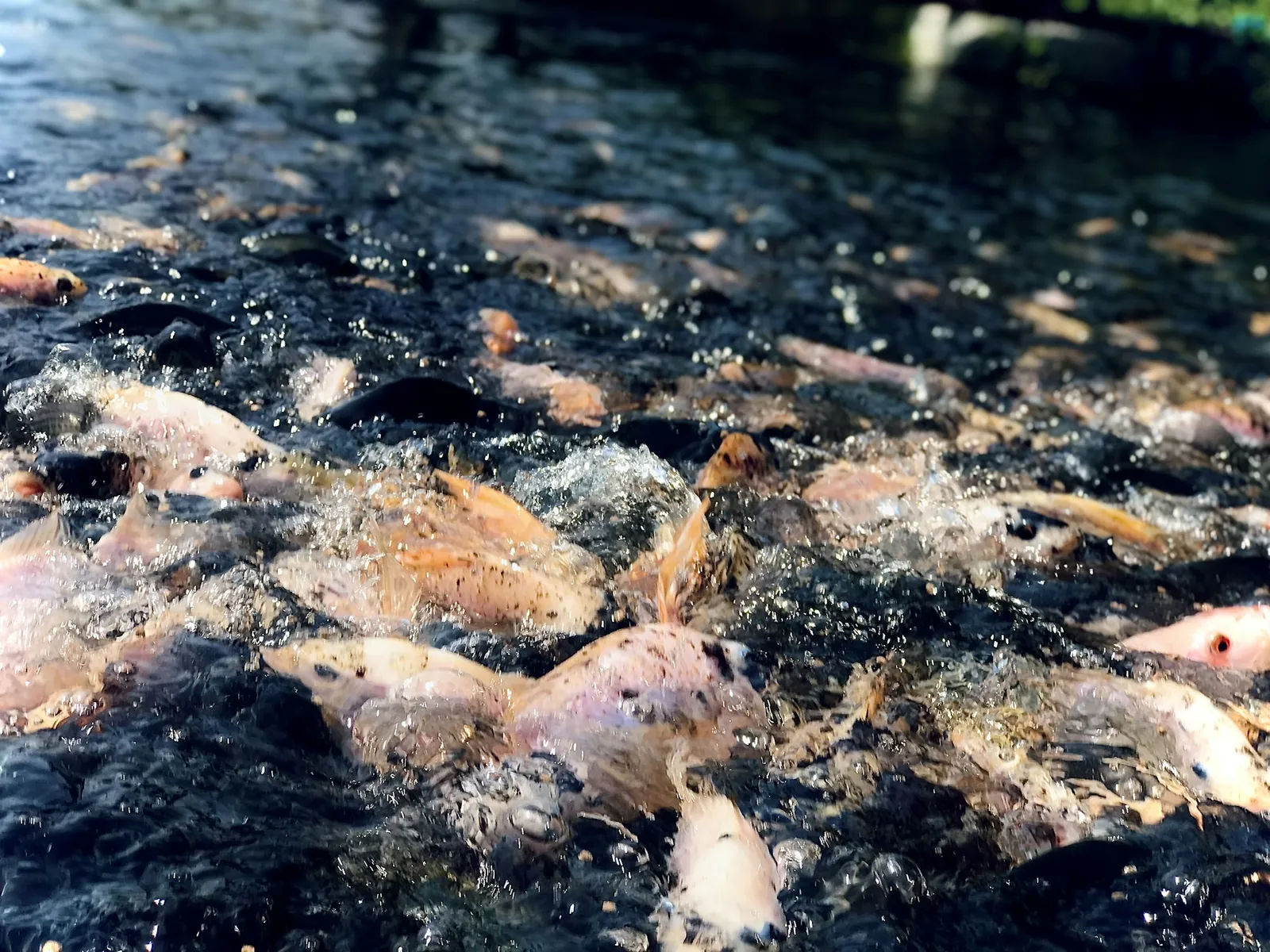
Feed is the largest cost on most fed farms, and an FAO review puts it at up to 60% of production costs. A pellet that drops through the net or settles in a tank uneaten is paid for twice: once at purchase, and again as nitrogen, phosphorus and solids the site has to absorb.
Uneaten feed is also hard to see. In a study of particulate waste leaving fish-farming cages, wasted feed varied widely and at its highest reached about 50% of the feed supplied, and the authors recommended that farms estimate their own wastage. Appetite, pellet quality, pellet size, timing and distribution all contribute, and each has a different fix.
Uneaten feed and faecal loss differ
Solid waste below a cage or in tank effluent has 2 origins. Faeces are the undigested part of what the fish ate, so their amount depends on ingredient digestibility, which the formulator controls. Uneaten pellets and fines carry every nutrient in the diet, and their amount depends on feeding practice and pellet physical quality, which the farm and the mill control. Both look the same in a sediment trap or an FCR figure, but the remedies differ.
Dissolved losses are a third route. The FAO review, drawing on mass-balance work at a marine cage farm, shows roughly half of total nitrogen and carbon excreted through the gills into the water, while over half of total phosphorus settles as particles. Phosphorus is typically the limiting nutrient for algal growth in fresh water and nitrogen in the sea, so freshwater and marine sites have different priorities.
Waste also compounds. Using calculations from Boyd, the review reports that a rise in FCR from 1.6 to 2.0, or 25%, lifted total phosphorus and nitrogen loadings from Nile tilapia ponds by about 47% and 36%. As a hypothetical example, at the typical Atlantic salmon FCR of about 1.2 in FeedOptima's reference data, losing 5% of delivered feed means buying about 1.26 kg of feed per kg of gain, with the extra going straight to the environment.
Why fish leave pellets uneaten
Overfeeding is the main driver. The FAO review names a feeding strategy that leads to overfeeding as the greatest determinant of excess nutrients reaching the environment, and notes that feed tables assume fish eat whenever feed is offered. Appetite varies within and between days, and in cage-held Atlantic salmon parr, daily ration fell from autumn to winter with temperature and day length. A Southern Regional Aquaculture Center (SRAC) trout guide adds that overfeeding lowers efficiency without significantly increasing growth.
Temperature, oxygen and timing move the ceiling. The SRAC guide advises restricting trout feeding below about 4 C or above 20 C. FeedOptima's typical ranges put the optimum at 8 to 14 C for Atlantic salmon and 12 to 17 C for rainbow trout, and treat dissolved oxygen below about 7 mg/L and 5.5 mg/L respectively as limiting intake. Rainbow trout fed out of phase with their natural rhythm, such as at midnight rather than dawn, ate less and used protein and energy less efficiently.
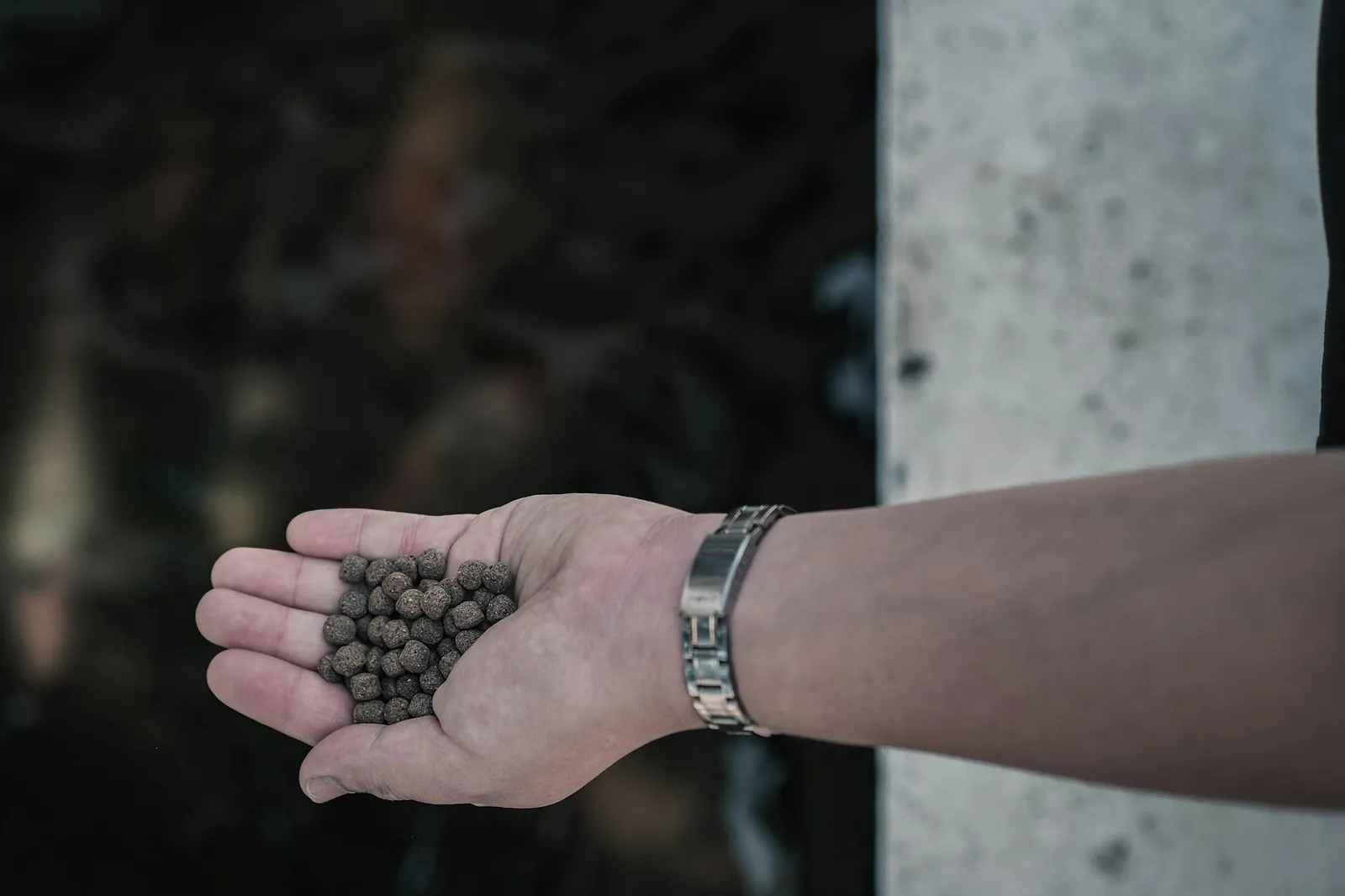
Pellet size has to fit the fish, and first-feeding fry given excessive amounts of very fine particles can suffer impaired gill ventilation. The table shows a typical diameter progression for Atlantic salmon and rainbow trout, compiled from commercial feed companies in a second FAO chapter. A size chosen for the mean weight may suit only part of an ungraded group.
| Fish weight (g) | Pellet diameter (mm) |
|---|---|
| 10 to 30 | 2 |
| 30 to 100 | 3 |
| 100 to 250 | 4 |
| 250 to 500 | 5 |
| 500 to 1,000 | 6 |
| 1,000 to 2,000 | 7 to 7.5 |
| 2,000 to 3,000 | 9 |
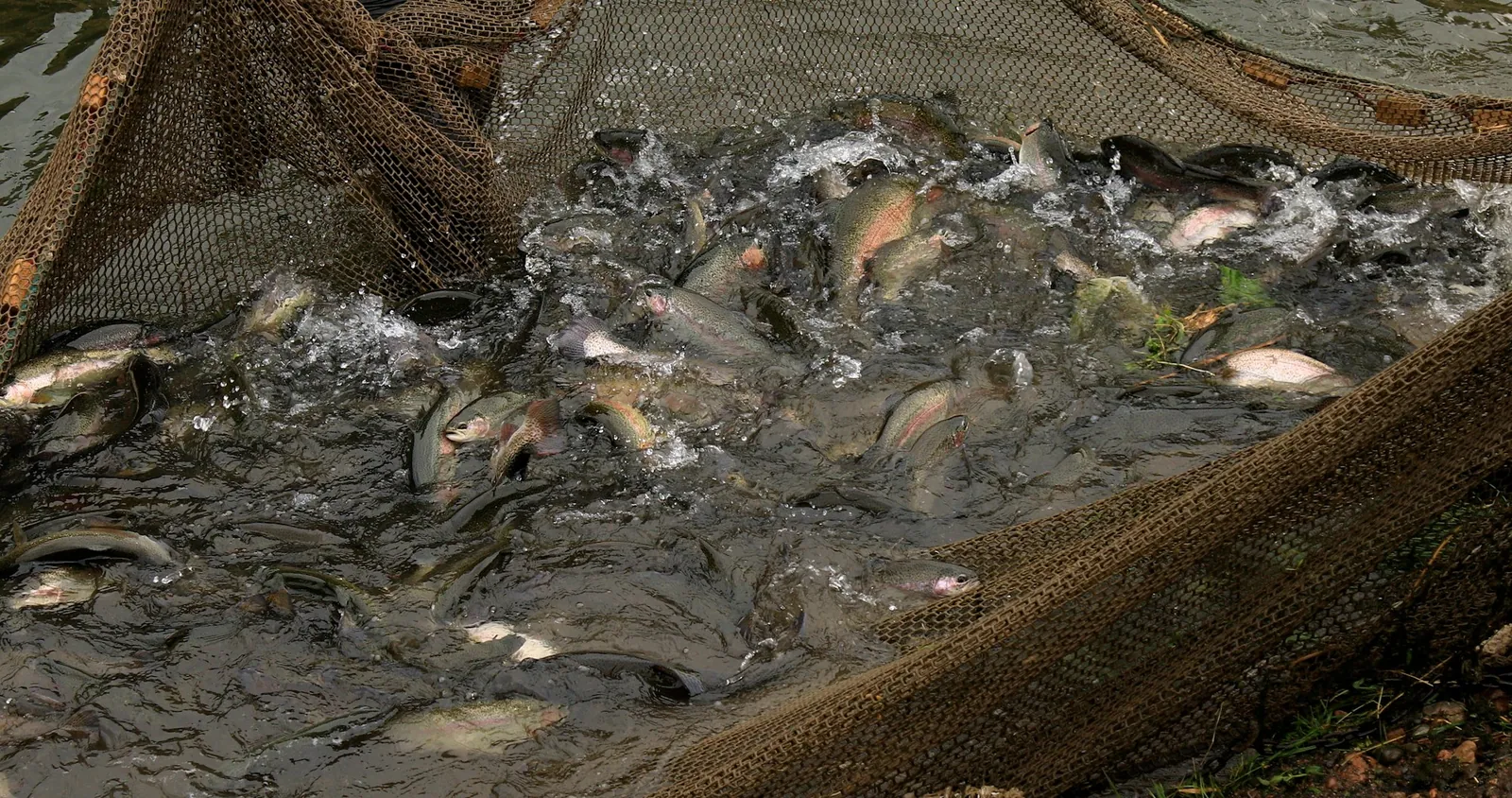
Distribution decides which fish eat. If a meal delivers far fewer pellets than there are fish, some cannot reach feed, and on demand feeders a few dominant fish can monopolize the trigger. The SRAC guide recommends spreading feed over at least 2/3 of the water surface for fry under about 5 cm, and notes that small trout ignore feed once it settles.
Pellet quality from mill to spreader
Fines are feed the fish cannot use. The FAO review lists fines from pellet damage in transport or automatic feeding alongside uneaten pellets and faeces as the solid waste that builds up below cages. Processing sets the starting point: in data reported in the second FAO chapter, one basal mixture scored 25% on a pneumatic (Holmen) durability test when pelleted and 97% when extruded.
Delivery does its own damage. In a Nofima trial, 3 commercial feeds were blown through a 400 m pipeline; breakage into fractures and dust rose with air speed and fell as feed rate increased. Doris durability, hardness and bulk density did not correlate well with the breakage measured at the outlet, so the sample that matters is the one taken where feed leaves the spreader.
Storage adds fines and costs palatability. An FAO feed manual advises dry, cool, ventilated stores, sacks on pallets, oldest stock used first and no walking on stacked bags, which breaks surface pellets into dust. It warns that rancid fats reduce palatability and that vitamin C and thiamine lose potency, and gives 1 to 2 months as a general limit for compounded dry feed; for bulk commercial feed, follow the label.
Measuring what the fish leave behind
Waste cannot be managed until it is seen. Hand feeding lets staff watch behaviour and adjust on the spot. The SRAC guide describes a simple stop rule: scatter about 2 pellets per fish over 5 to 10 minutes, repeat at 10-minute intervals, and stop when the ration is gone or feeding activity declines.
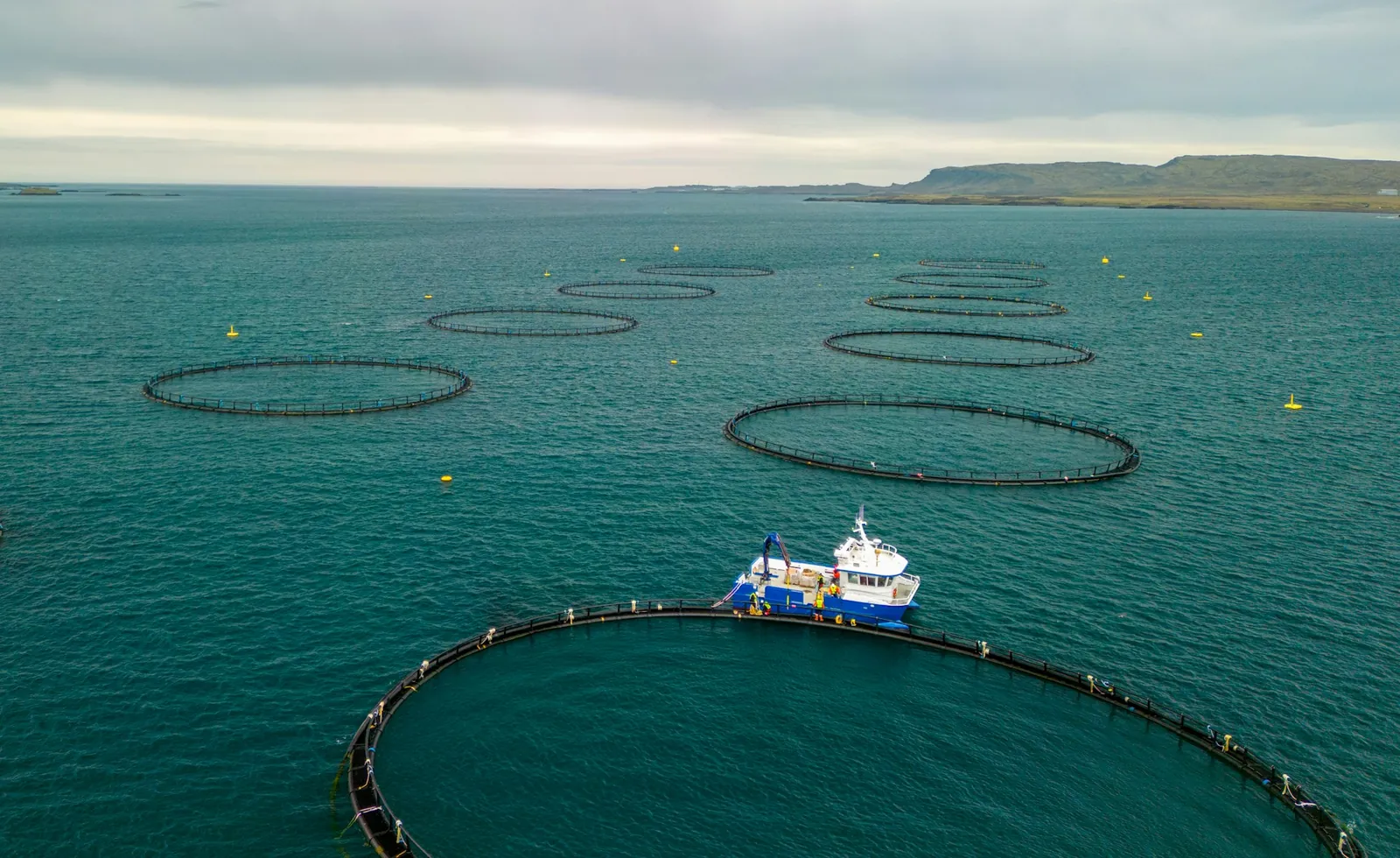
Cages need instruments, because the loss happens below the fish. Feeders linked to underwater video or infrared pellet sensors have been tested extensively in salmon and trout cages, and pellet sensors allow feeding to satiety while keeping uneaten feed to a minimum. A camera pays only if the stop rule is written down, for example as a pellet count past the lens, rather than left to judgement.
Tanks allow direct measurement: uneaten pellets recovered from the outlet or a settling trap after each meal can be dried, weighed and subtracted from feed delivered. The SRAC guide advises removing excess feed promptly, since it harms water quality and promotes disease.
Split meals by fish size. The second FAO chapter describes salmonid fry fed almost continuously and 4 to 5 meals a day at 1 to 2 g, while above about 20 g, 2 meals a day to apparent satiation is usually sufficient at standard temperatures.
Feeding to satiation is not the same as feeding past it. In a University of Guelph trial on rainbow trout growing from about 150 to 600 g at 8.5 C, fish fed to near satiation reached 621 g against 526 g at 75% of that ration, but feed efficiency fell from 1.02 to 0.83. The last portion of a meal buys growth at the poorest conversion, so stop at the first sign of falling interest.
In practice
- Sieve samples from the spreader outlet and from the bag or silo for each feed batch, and record the fines difference.
- On pneumatic systems, use the lowest reliable air speed, avoid long runs at low feed rates, and recheck fines after changes.
- Write a stop rule for each unit, such as pellets on the camera or falling surface activity, and log why each meal ended.
- After every sample weighing, check pellet size against the smaller fish in the group, not only the mean.
- Cut or withhold rations when temperature or oxygen is outside the species' typical range, and log both daily.
- In tanks, weigh uneaten pellets recovered after meals for at least 1 week a month to calculate actual intake.
- Store feed on pallets, use the oldest first, keep people off the stacks, and reject damp, mouldy or infested deliveries.
FeedOptima's free analysis checks temperature, oxygen and stocking against your species' typical ranges and estimates what cutting uneaten feed is worth; run an optimization before changing a feeding plan.
Sources
- Environmental consequences of poor feed quality and feed management (FAO Fisheries and Aquaculture Technical Paper 583), FAO. https://www.fao.org/fishery/docs/CDrom/T583/root/21.pdf
- Feed management and on-farm feeding practices of temperate fish with special reference to salmonids (FAO Fisheries and Aquaculture Technical Paper 583), FAO. https://www.fao.org/fishery/docs/CDrom/T583/root/20.pdf
- Trout Production: Feeds and Feeding Methods (SRAC Publication No. 223), Southern Regional Aquaculture Center. https://aquaculture.mgcafe.uky.edu/sites/aquaculture.ca.uky.edu/files/srac_223_trout_production_feeds_and_feeding_methods.pdf
- Feed pellet durability in pneumatic conveying systems for fish farming, Nofima. https://nofima.com/publication/1216177/
- Particulate waste outflow from fish-farming cages. How much is uneaten feed?, Marine Pollution Bulletin. https://agris.fao.org/search/en/records/674888f87625988a371d4d3b
- Effect of feeding level on growth and nutrient deposition in rainbow trout growing from 150 to 600 g, Aquaculture Research. https://doi.org/10.1111/j.1365-2109.2006.01532.x
- Feed and feeding of fish and shrimp, section 7: How should I store my feeds?, FAO. https://www.fao.org/4/s4314e/s4314e08.htm